
TONY GAVIN
B. Com, MBA, JP (Qual)
Founder & CEO, touchpoint IQ · Accountant · Entrepreneur · Author · Business Systems Architect · Podcast Creator & Co-Host
Overview
Tony Gavin is an Australian accountant, entrepreneur, author and business systems architect with a career spanning more than four decades across accounting, financial services, insurance, franchising, digital media, technology and marketing. He is the founder and director of touchpoint IQ, a connected growth systems business serving established businesses in Australia, and co-host of the Systems of Business Podcast with Damon Simms.
His work is grounded in a conviction developed across multiple business cycles: that predictable, sustainable growth is a systems-design problem before it is a marketing or technology problem. The businesses and practices he has founded, led, and advised reflect an enduring interest in the intersection of commercial evidence, operational design, and measurable outcomes.
Tony is married and has three adult children and six grandchildren. Outside of work his primary interest is animal welfare, with him and his wife having co-founded Philippines-based NGO, Best Friends Furever Sanctuary, Inc in 2021. The organisation provides animal welfare education and serves the needs of senior and special needs animals. Tony splits his time between Angeles City, Philippines and Brisbane, Australia.
Current Work
touchpoint IQ
Tony Gavin is the founder and CEO of touchpoint IQ, established in 2026. The business designs, builds and manages connected growth systems for established businesses in Australia.
The service model is audit-first: a Pipeline Audit diagnoses where a business’s growth system is broken, incomplete or misdirected before any technology, automation or campaign investment is introduced. From the audit, businesses move to a structured, managed service engagement.
touchpoint IQ is platform agnostic and supports a wide variety of CRMs, marketing automation platforms and associated services. The company is comfortable working with either platforms or stacks.
The central framework underpinning the work is Visibility → Connection → Evidence → Improvement: four conditions Tony identifies as necessary for predictable, sustainable practice growth.
Website: touchpoint IQ
Website: touchpoint.systems
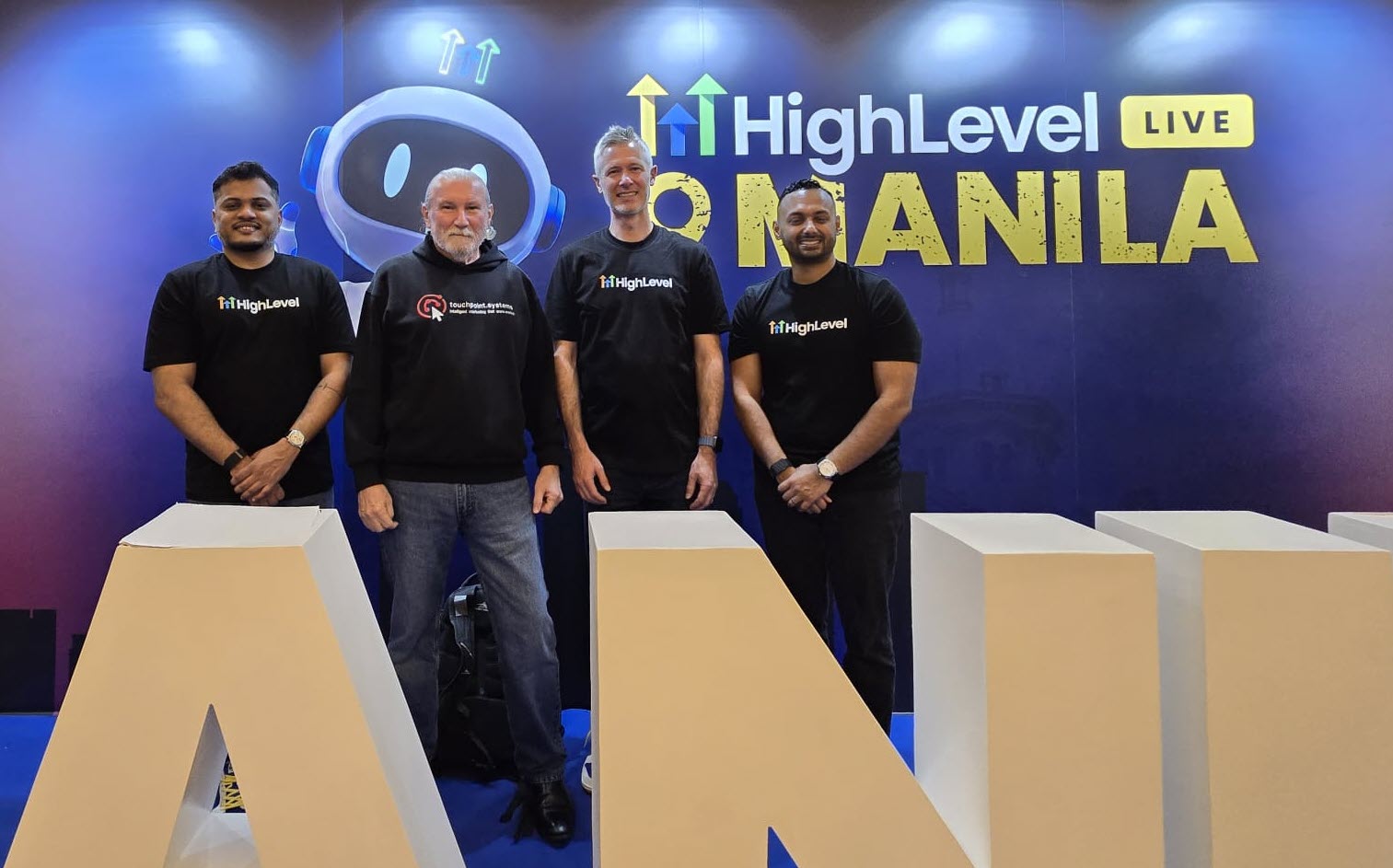
Tony Gavin with the three founders of HighLevel (one of many platforms supported by touchpoint IQ)—Varun Vairavan, Shaun Clark, and Robin Alex at HighLevel LIVE Manila, Philippines 8-9 August 2026.
Systems of Business Podcast
Tony Gavin co-hosts the Systems of Business Podcast with Damon Simms. The podcast explores the systems that make or break businesses, featuring conversations with founders, operators and practitioners about the practical approaches and systems that drive real-world business performance. The podcast is produced and distributed across major podcast platforms.
You can watch a recent episode of the podcast on Spotify by clicking on the video to the left.
Website: systemsofbusiness.com
Advisory Roles
ActiumAI Pty Ltd
Technical Advisory Board member since December 2021. ActiumAI provides proprietary and in-licensed cognitive digital LawTech tools and applications for lawyers.
Watch my address on AI chatbots at Bond University, ActiumAI LawTech Conference 2023. This is a keynote I gave at Bond University on 24 August 2023 on Next Generation AI Chatbots at the ActiumAI Lawtech Commercialization Conference 2023.
Website: actiumai.com

Results and Co
Technical Advisor since December 2024. Results and Co is a Certified StoryBrand Guide and GHL Agency offering comprehensive marketing agency services.
Website: resultsandco.com.au
VentureX Limited
Technical Advisor since July 2026. VentureX helps New Zealand-based companies connect with global talent and streamline offshore hiring.
Website: venturex.co.nz
Charitable Work

Best Friends Furever Sanctuary, Inc.
Tony Gavin is a co-founder and director of Best Friends Furever Sanctuary (BFFS), a not-for-profit organisation that provides a furever home for senior and special needs animals in the Philippines. The shelter was founded so that senior and special needs animals could age with grace and dignity, under the care of dedicated volunteers.
Tony Gavin sitting with his wife and BFFS co-founder Mitzi Cruz, seated on the foundations of what was to become the first dog shelter at BFFS, Magalang, Pampanga Province, Philippines. Dog seated with Mitzi is long-time shelter resident Chinchin (deceased), with family dog Varis at front. Photo taken February, 2021.
Website: bffs.org.ph
Tony Gavin – Career History
touchpoint IQ is the product of more than four decades of commercial experience across industries, roles and business cycles. The timeline below traces the journey that shaped it. Clicking on any gold coloured link will take you directly to more information about that specific venture. Where possible, links to historical data, cached websites, and the like are provided. NB: Wayback Machine (archive.org caches) may produce visually poor or inconsistent results.
1979-1980
Sales Assistant, Grace Bros.
Grace Bros. was a large, Sydney-headquartered department store chain. Tony worked there while waiting for his army enlistment date.
1980-1984
Soldier, Australian Regular Army
Tony served four years in the Australian Regular Army, Artillery Corps. Initially a gunner with 1 Field Regiment, Tony then spent several years as a meteorological observer with 131 Divisional Locating Battery.
1984-1987
District Sales Manager, Colonial Mutual Life
Colonial Mutual Life was one of Australia’s largest life insurers. Joining the company as a trainee, Tony progressed quickly and at 24 became the youngest executive appointment in the company’s history.
1987-1995
Early Entrepreneurial Journey
Tony Gavin experimented with numerous business opportunities on his early entrepreneurial journey, often with mixed results! You can link to more information about some of them below.
Gavin & Co. Pty Ltd (insurance and financial planning agency)
Blacktown Office Equipment (used office equipment sales)
Aussie Chopsticks (franchised food delivery service)
St George Nominees Pty Ltd (master insurance agency)
St George Legals Pty Ltd (legal document service)
Southern Cross Mining Partners Pty Ltd (sapphire mining venture)
1995-2000
Accounting Practice Owner, Tony Gavin & Associates
Tony Gavin & Associates operated as a general accounting practice, specialising in providing debt restructuring for small businesses facing significant financial problems. The firm also established offshore companies and trusts and assisted business owners with opening offshore bank accounts and obtaining offshore credit cards. The practice was sold via trade sale in 2000.
1998-2008
The Entrepreneurial Journey Continues
Tony Gavin continued his entrepreneurial journey while operating Tony Gavin & Associates and beyond, also with mixed results. You can link to more information about some of those ventures below.
Funeral Fund of Australia Pty Ltd (funeral benefit fund)
Perpetual Acceptance Corporation Ltd (finance company)
thepersonalcolumn.com Ltd (internet dating portal)
Reward Insurance Limited (APRA regulated general insurer)
Ledgers Bookkeeping Pty Ltd (bookkeeping franchise system)
Web Splash Pty Ltd (web development company)
Ovation Software Limited (software company)
Liberty Alliance Venture Capital Ltd (pooled development fund)
2010-2024
The Entrepreneurial Journey Resumes
After a two-year sabbatical in South-east Asia, Tony resumed his entrepreneurial journey, this time with a concentrated focus on technology, the internet and digital marketing. You can link to more information about some of those ventures below.
ROI Media Limited (digital marketing agency)
> Accountants Direct (advertising portal)
> Bookkeepers Direct (advertising portal)
> Legal Direct (advertising portal)
> Insolvency Advice (advertising portal)
> Attorneys of the Philippines (advertising portal)
> Compare Communities (advertising portal)
2024-2026
touchpoint IQ
Education, Certifications, Licences & Honours
Formal Qualifications
Bachelor of Commerce (B. Com) – Canterbury University
Master of Business Administration (MBA) – Singapore Business School
Development & Certifications
More than 100 certifications covering business, accounting, design, marketing, IT, software, data science and other professional skills.
Professional Licences
Public Practice Certificate Issued by ATMA (1996-2008)
Director, Registered Tax Agent(s) (1996-2008)
Director, Authorised Credit Provider (QLD) (1999-2007)
Director, APRA Approved General Insurer (2000-2002)
Official Honours
Australian Service Medal (awarded for military service)
Justice of the Peace (Qualified) — Queensland
Published Works
Sun Tzu & The Art of Accounting: Winning Clients Before Your Competitors Know There’s a Battle
A practitioner’s guide applying Sun Tzu’s strategic principles to the challenge of building and running an effective marketing system for accounting practices. The book addresses how accounting practices can think about client acquisition, market positioning, competitive awareness and marketing investment in a more deliberate and evidence-informed way.
A professional-services edition, extending the core framework to law, finance and advisory practices, is in development.
Website: amazon.com.au/dp/B0H31XXNKG
Entrepreneurial Ventures
Gavin & Co. Pty Ltd
Gavin & Co. launched as an insurance agency and financial planning firm in Sydney in 1987 — a decision that, in hindsight, demonstrated either remarkable courage or a spectacular failure to read the market (like almost all of the “experts” at that time). The firm opened its doors just weeks before the October share market crash wiped roughly 25% off the Australian market in a single day.
As it turned out, the timing was less catastrophic than it sounds. The business was weighted toward life insurance rather than investment advice, which meant that while the rest of the financial services industry spent late 1987 explaining to clients why paper wealth had become just paper, Gavin & Co. had relatively few such conversations to manage. It was an early and unplanned lesson in the value of diversification — including diversification away from the thing currently on fire.
The firm was also an early mover in digital infrastructure at a time when that phrase meant something considerably more modest than it does today. A direct modem connection to insurers — allowing policy processing without the postal system — was close to unheard of in an industry still largely running on paper, the DX, faxes (a mod con at the time), phone calls and goodwill.
In 1989, Tony Gavin relocated with his family to Brisbane. The business moved with him, shedding the Sydney identity and relaunching as St George Nominees Pty Ltd to reflect the company’s broadening scope as a master insurance agency.
Primary lesson learned: shares go down in price — not just up. Timing is everything, except when it isn’t, and then resilience is.

Gavin & Co. office in Blacktown NSW Australia. Photo taken around September, 1987. Love that 80’s vibe!
Blacktown Office Equipment
Not every business begins with a strategy. Some begin with a borrowed van, a rented storage shed and an impulsive decision that turns out to be quietly brilliant.
While sourcing used office equipment for Gavin & Co. at a government surplus sale, Tony did what any sensible person would do: bought several hundred ex-government desks at roughly $4 a unit and more than 100 office chairs, on the reasonable assumption that someone, somewhere, would want them. The less reasonable assumption was that he had somewhere to put them.
The solution to the storage problem turned out to be the business itself. Tony rented a shed on a main road in Blacktown — chosen primarily because it was available, affordable, and close to the Gavin & Co. office — and then noticed something the lease had not mentioned: an enormous volume of passing traffic. A sandwich board advertising “Desks from $60” went up. The desks, once cleaned, sold for an average of more than $80 each. The return on a $4 purchase, by any measure, was difficult to complain about.
Blacktown Office Equipment closed almost as quickly as it opened, not because it failed but because it ran out of inventory. It had exactly one supplier, exactly one product category and exactly one exit strategy, all of which happened simultaneously.
It was Tony’s first direct experience of a principle that would recur across his career: that the most profitable opportunities are sometimes the ones you didn’t plan, as long as you are paying enough attention to recognise them and move fast enough to act.
Primary lesson learned: when opportunity knocks, you had better be ready to open the door — preferably before it moves on to the next address.
Aussie Chopsticks
In the late 1980s, food delivery in Australia meant picking up the phone, hoping the restaurant answered, and driving to collect the order yourself. Aussie Chopsticks had a better idea: a franchise network partnering with local Chinese restaurants to deliver meals directly to the customer’s door. The concept was sound. The execution, at the franchisor level, was considerably less so.
The system was, to put it diplomatically, a work in progress from the moment the ink dried on the franchise agreement. The franchisor’s inexperience showed early and often — in the support structures, the operational systems, the training, and the general sense that the people selling the franchises had thought more carefully about selling them than running them. It was a reasonably accurate preview of what a franchise looks like when the franchisor mistakes enthusiasm for infrastructure.
What saved the investment was a piece of genuine good fortune: the Chinese restaurant assigned to Tony’s franchise area happened to be excellent. Good food, reliable service, consistent quality. While other franchisees around the network struggled with restaurants that treated the arrangement as an afterthought, Tony’s territory had something the franchisor’s systems could not provide — a kitchen that actually delivered on the promise.
The delivery service proved popular enough that the franchise was exited within a short timeframe at a small profit. Not a triumph, but a clean outcome from an imperfect situation.
The experience lodged something more valuable than the profit: a detailed, first-hand education in what a franchise system looks like when it is designed without rigour. When Tony built Ledgers Bookkeeping more than a decade later — a franchised bookkeeping network that grew to 25 franchisees nationally — he drew directly on what Aussie Chopsticks had demonstrated so clearly. Systems matter. Processes matter. A franchise is only as good as the operational backbone behind it. The franchisor’s job is not to sell the dream; it is to make the dream deliverable.
Primary lesson learned: look carefully before purchasing a franchise — and look even more carefully at the people selling it. The experience proved invaluable when it came time to build a franchise system worth buying into.
St George Nominees Pty Ltd
When Tony Gavin relocated to Brisbane in 1989, Gavin & Co. made the move with him, emerging with a new name and a more ambitious structure. St George Nominees operated as an incorporated master insurance agency — a designation that, in the context of late 1980s Australian life insurance, was about as close to printing money as a legitimate business arrangement could get.
The mechanics were straightforward and extraordinarily lucrative. As a master agency, St George had the right to appoint its own agents and collect overriding commissions and bonuses on top of whatever those agents produced. In an era of virtually no regulation, commissions on life insurance sales could exceed 200% of annualised premium income by the time master agency overrides and bonuses were factored in. The industry was not so much a market as a gold rush with paperwork.
In its early phase Tony sold directly, and did so with some distinction. There were periods where he personally outsold entire tied-agent sales teams of 20 or more people — a fact that says something about both his ability and the somewhat chaotic productivity of large, loosely managed sales forces. He subsequently recruited, trained and built his own team of high-performing agents, while the insurance companies — competing aggressively for productive distributors — threw fuel on the fire in the form of large, unsecured agency development loans. The industry logic was simple: find the productive agencies and back them heavily. St George Nominees was productive. It was backed heavily.
Then, with the particular lack of warning that tends to characterise these moments, everything changed at once.
Regulation arrived. Commissions were cut to a fraction of their former levels virtually overnight. The agency development loans — which had never felt quite as unsecured as their name suggested — were called up. Master agency arrangements were terminated. And then, as if the industry upheaval were insufficient, Paul Keating delivered what he memorably described as “the recession we had to have,” which arrived on schedule and without apology.
St George Nominees was caught squarely in the crossfire. The combination of slashed revenue, called-up debt and a contracting economy was not survivable. The business closed with significant residual debt that required years to resolve.
It was the most instructive failure of Tony’s early career — not because the business was badly run, but because it demonstrated with unusual clarity how quickly external forces can render a thriving operation unviable. The income had been real. The loans had been real. The commissions evaporating and the loans being called simultaneously were also, unfortunately, real.
Primary lessons learned: circumstances change — often quickly and without notice. Excessive debt can destroy a business faster than any competitor or bad decision. Soft loans always come with strings attached, and the strings tend to appear precisely when you can least afford them. Make hay while the sun shines — but don’t build your barn out of the hay.
St George Legals Pty Ltd
St George Legals occupied a narrow but commercially productive gap in the market: the space between what people genuinely needed — properly executed legal documents — and what they were actually getting, which in most cases was nothing, because the cost and inconvenience of seeing a solicitor ensured the will, the power of attorney and other important documents remained permanently on the to-do list.
The business model was deliberate and carefully constructed. St George Legals provided templated legal documents — wills, enduring powers of attorney, partnership agreements, trust deeds, company incorporations — and charged clients for word processing, printing and postage. It did not provide legal advice. The distinction was not a technicality; it was the architecture of the entire operation.
Its direct sales model was effective. The company sold thousands of wills through a cold-calling operation at a time when most Australians had none — a fact that reflects more on the legal profession’s accessibility than on any deficiency in the product being sold. Demand, it turned out, was not the problem. The problem was visibility, and a direct sales team solved it efficiently.
The Queensland Law Society eventually took notice. The ensuing engagement produced an enforceable undertaking — prohibiting St George Legals from providing legal advice, which it had never provided, and from selling wills, which had been its primary product. The undertaking was, in practical terms, a solution to a problem the business had not actually created, framed as a concession the business could not afford to refuse.
By the time the Law Society made its position known, Tony had already sold the business. Having exited cleanly, he took the pragmatic view that contesting the undertaking — while arguably winnable — was a fight whose costs in time, money and distraction would comfortably exceed any likely benefit. The juice, as he put it, was not worth the squeeze.
The business had operated lawfully throughout. The exit had been timely. The lesson filed quietly under experience rather than regret.
Primary lesson learned: operating in the gap between what is legal and what an established profession considers acceptable is a viable strategy — until it isn’t. Know when the cost of the fight exceeds the value of the prize, and be willing to walk away from both.
Southern Cross Mining Partners Pty Ltd
Southern Cross Mining Partners operated as the general partner of a limited liability partnership holding mining tenements over sapphire-bearing country in the New England region of New South Wales. On paper — and for a period, in practice — it was a genuinely compelling proposition.
The structural elegance of the project lay in its two distinct commercial advantages working in combination. The first was operational: direct agreements with Thailand-based cutting houses to cut and sell the partnership’s production, bypassing the layers of middlemen that typically consumed the margin in gemstone operations. If the ground yielded what the geological assessments suggested it might, the economics were unusually attractive.
The second advantage was structural. Australian taxation law at the time allowed limited partners to offset losses from a limited liability partnership — including losses on borrowed funds and interest payments — against other income. Non-recourse financing was in place for limited partners, meaning the downside was capped and the tax treatment of any early losses was favourable. It was the kind of arrangement that accountants describe as efficient and everyone else describes as almost too good.
The project never reached production.
Before meaningful mining activity commenced, the federal government announced a change to the taxation treatment of limited liability partnerships. Rather than flowing losses through to individual partners in the traditional manner, the new rules would treat such structures as corporate limited partnerships for tax purposes — a reclassification that eliminated the very feature that had made the project viable for investors. The economics that had underpinned the capital raising evaporated in a single Budget announcement.
Southern Cross Mining Partners was shuttered. The sapphires, if they were there at all, remained in the ground.
It was Tony’s second direct encounter with the particular frustration of a government policy reversal destroying a legitimate commercial arrangement — the first having been revised insurance regulations that brought down St George Nominees. The pattern was becoming familiar: build something on a set of rules, have the rules changed, and absorb the consequence.
Primary lesson learned: the government giveth and the government taketh away — and it rarely provides much notice of which it is about to do next.
Funeral Fund of Australia Pty Ltd
Death, as an industry, presents certain commercial certainties that most markets cannot offer. Demand is guaranteed, the customer base replenishes itself reliably, and the emotional context of the purchase creates strong incentives to plan ahead rather than leave the arrangements to a grieving family. Funeral benefit funds — prepaid funeral savings vehicles — existed to serve exactly that need. Tony Gavin saw the opportunity and set about building one that could operate nationally.
The regulatory landscape was, to put it charitably, a patchwork. Funeral benefit funds were governed on a state-by-state basis, with each jurisdiction maintaining its own registration requirements, residency rules and compliance frameworks. At the time such funds were not classified as financial products under federal law, which meant there was no single national regulator to satisfy and no coherent national standard to meet. The path to a genuinely national fund required navigating eight separate regulatory environments, each with its own interpretation of what the rules required and who was entitled to enforce them.
The fund made progress. It reached a point of compliance in every Australian state and territory except one. That one exception was New South Wales — the largest market in the country and the jurisdiction with the most demanding requirements, including physical residency of the fund provider within the state. The then NSW Commissioner of Fair Trading made the position clear: attempt to operate in New South Wales without meeting those requirements, and the Commissioner would seek an injunction to shut the fund down entirely.
Tony’s reading of the situation was that the Commissioner’s position was constitutionally dubious. A state regulator using residency requirements to exclude an otherwise compliant interstate operator from a national market had the look of an arrangement the framers of the Constitution had specifically intended to prevent. He took the matter to the Australian Competition and Consumer Commission.
The ACCC’s response, after several exchanges, was both candid and deflating. They agreed the Commissioner may well have been acting unconstitutionally. They also concluded there was insufficient public interest argument to justify pursuing the matter on the fund’s behalf. The substance of their position, stripped of the official language, was essentially, ‘You’re probably right, but this is your problem, not ours.’
The project was abandoned. The constitutional question remained unresolved. The Commissioner faced no consequences for a position the ACCC had acknowledged was potentially unlawful.
Primary lesson learned: the government is not there to help you. Regulators are faceless, unaccountable and largely insulated from the consequences of their decisions. Being right is not the same as winning, and winning requires someone with both the authority and the motivation to act — neither of which can be assumed.
Perpetual Acceptance Corporation Ltd
Most financial businesses are built around opportunity. Perpetual Acceptance Corporation was built around a problem — specifically, one created by a piece of legislation that left a particular class of borrower with nowhere straightforward to turn.
The trigger was the 1999 amendments to the Superannuation Industry (Supervision) Act 1993. The changes required superannuation fund trustees to wind up in-house loans to associated entities — loans that had previously been permissible and, in many cases, had been in place for years. Trustees who had structured their affairs under the old rules now faced a mandatory unwind with a compliance deadline and, in many instances, no obvious source of replacement financing. The legislation had created the demand. Tony Gavin built the supply.
Perpetual Acceptance Corporation became a registered credit provider in Queensland and raised $1.7 million in initial capital, supplemented by a further $500,000 in a subsequent raise. Beyond the SIS Act problem, the company extended its product range to include solutions for directors managing Division 7A loan unwinds — another area where tax legislation created financing complexity that mainstream lenders were ill-equipped or unwilling to navigate — and bespoke lending products for directors working through corporate insolvency arrangements. It was, in every sense, a compliance-driven lending business: the clients came not because they wanted a loan but because the law had made one necessary.
The company ceased writing new loans in 2003, a consequence of Tony’s expanding commitments elsewhere rather than any deterioration in the business itself. What followed was four years of patient, methodical loan book management — collecting repayments, managing extensions, and winding down the portfolio with the kind of unhurried discipline that recovery work demands. By the time the last loan was closed in 2007, investors had been repaid in full or had migrated their capital into associated vehicles, and the company had successfully recovered more than 99% of all loans extended.
That recovery rate, across a portfolio of borrowers navigating legislative change, insolvency and financial complexity, is not an accident. It reflects underwriting discipline, rigorous documentation and a willingness to pursue recovery with patience rather than urgency — recognising that a borrower pushed too hard in the wrong circumstances becomes a borrower who repays nothing at all.
Primary lesson learned: it is considerably easier to lend money than to recover it. Patience is a virtue — particularly when the alternative is crystallising a loss that careful management might yet avoid.
thepersonalcolumn.com Ltd
It was 1999, the dot-com boom was approaching its irrational peak, and the logic seemed sound: build a website where people could meet, charge for the privilege, and watch the internet do the rest. The idea was not wrong. The timing, the execution and the budget, taken together, proved less forgiving.
thepersonalcolumn.com was an online dating portal, conceived and built at a moment when the concept was genuinely novel and the market was genuinely open. What would later be proven correct — that people would use the internet to find each other in enormous numbers, and would pay for the opportunity — was, in 1999, still a proposition rather than a fact. Tony and his closest friend backed the proposition to the tune of more than half a million dollars between them.
The problem was not the idea. It was the era. This was the internet before WordPress, before Joomla, before the ecosystem of templates, plugins and open-source frameworks that would later make a functional website an affordable proposition for almost anyone. In 1999, a website of any real complexity required coders, and coders required money — significant money, delivered with patience and a tolerance for scope creep. The thepersonalcolumn.com codebase consumed the lion’s share of the budget. A major accountancy firm subsequently valued that codebase at a figure that exceeded what had been spent building it, which was some consolation, though not the liquid kind.
With a functioning platform built and ambitions appropriately scaled, the next step was capital. A prospectus was prepared and the company was positioned for listing on the NSX. Then dot-com became dot-bomb. The Nasdaq peaked in March 2000 and spent the following two years reminding investors that price and value are not always the same thing. The listing was aborted. The project, starved of the capital that a market listing would have provided, was ultimately abandoned.
The idea, for what it is worth, was eventually proven entirely correct. The businesses that executed it successfully — with better timing, lower build costs or deeper pockets — became some of the most valuable consumer internet companies of the following decade. Tony and his friend were early, which in markets is a condition frequently indistinguishable from wrong.
Primary lesson learned: the attractiveness of an opportunity is not, by itself, sufficient reason to pursue it. Entering a business you do not fully understand — its dynamics, its timing, its capital requirements — is a reliable path to an expensive education. The tuition, in this case, exceeded $500,000.
Reward Insurance Limited
Acquiring an insurance company that a federal prudential regulator is preparing to close is, on its face, an unusual investment thesis. The assets are distressed, the regulator is impatient, and the market has already formed a view. Tony and his partners acquired Reward Insurance anyway — and then, months later, HIH Insurance collapsed, taking with it whatever remained of the market’s appetite for small general insurers and replacing it with a level of regulatory scrutiny that made an already difficult situation considerably more so.
Reward Insurance was an APRA-approved general insurance company with a genuine commercial asset at its centre: a 25% share of the Builders Warranty Insurance market, a segment in which HIH had been the dominant player before its spectacular and costly demise. That market position was worth defending. It was also, in the post-HIH environment, a reason for APRA to watch Reward Insurance with particular attention. Small insurers in stressed sectors do not attract light-touch regulation in the wake of the largest insurance collapse in Australian history.
What followed was a simultaneous exercise in corporate reconstruction across every dimension that matters. The company required recapitalisation. Unacceptable assets had to be identified, liquidated, and removed from the balance sheet. New management was installed. New systems were implemented. New reinsurance arrangements were negotiated from a position that offered limited leverage. Into the middle of this, the government introduced revised minimum capital requirements for general insurers, with compliance deadlines tight enough to have ended the exercise entirely. They did not.
A buyer was found — one with the capital to make the transaction credible — and terms were agreed. Here, the prudentially regulated nature of the entity introduced a final complication: the sale required approval from Treasury, a process that consumed more than six months and showed no particular sign of accelerating. The resolution, ultimately, required the directors to advise the Australian Federal Treasurer in unambiguous terms that legal action would follow if APRA continued to fail in exercising its delegated authority to approve the transaction. The approval was forthcoming. The exit was highly profitable.
Primary lesson learned: in circumstances where the margin between survival and failure is narrow, the quality of your advisers is frequently the deciding variable. Surround yourself with the best you can afford. They will earn their fees many times over — and then some.
Ledgers Bookkeeping Pty Ltd
The logic was impeccable. Australia had recently introduced the Goods and Services Tax, and every business was now required to lodge a Business Activity Statement — monthly or quarterly — making bookkeeping a suddenly essential service across the economy. The regulatory framework appeared to lock the opportunity in place: anyone charging for bookkeeping services had to be either a Registered Tax Agent or an exempt person (a qualified accountant with a valid Public Practice Certificate). Non-compliance carried a fine of up to $22,000 and prison time, a penalty structure harsh enough to suggest that compliance would be universal.
Tony founded Ledgers Bookkeeping after extensive testing and prototyping, positioning it as a franchised bookkeeping network built on a compliant framework. It looked perfect. It proved not to be.
The fundamental problem was regulatory timing. The Australian Taxation Office, having created the compliance requirement, failed to police or enforce it with any rigour. Bookkeepers operating in breach of the rules did so with minimal fear of consequence. The ATO promised that new regulations — specifically BAS Agent registration — would be introduced to tighten the framework and create the legitimate demand the franchise model required. That promise was made, repeatedly, and not kept. BAS Agent registration did not become reality until 2010 — a full decade after the introduction of GST. By then, the opportunity was behind rather than ahead.
The franchise model itself carried structural weaknesses that became apparent only once the business was operating. Entry required qualifications — a barrier that excluded many prospective franchisees who otherwise might have been interested. Simultaneously, the Australian economy was performing strongly, and qualified bookkeepers were fully employed and earning respectable wages. The risk-return proposition of purchasing a bookkeeping franchise did not appeal to them. Why purchase a franchise when the labour market would provide steady, low-risk employment?
Despite these headwinds, Ledgers Bookkeeping grew to 25 franchisees at its peak — proof that there was something worth building. At that point, Tony made a strategic decision: he sold Master Franchise rights for Australia and New Zealand to an experienced franchisor, hoping that a more seasoned operator could solve the problems that had resisted his own solutions. That decision proved problematic. The acquiring franchisor, despite extensive franchising experience, managed to destroy the business in remarkably short order.
By that time, Tony was living in Asia and chose not to attempt a rescue. He terminated all franchise arrangements and shuttered the business. What remained were the intellectual property assets — the systems, methodologies and training frameworks built over the life of the company — which were subsequently sold to the world’s largest bookkeeper licensing system at a price that reflected their genuine value. Even accounting for that sale, the venture cost Tony more than a million dollars.
Primary lessons learned: proper market research is too valuable to overlook, and its conclusions should be tested against the realities of the specific market and moment you are entering. Governments move at the pace of governments, not the pace you might reasonably hope for. Plan your regulatory dependencies accordingly — or plan to live with the consequences when they shift without warning.
Web Splash Pty Ltd
Ledgers Bookkeeping needed to be visible online. The company operated two websites: one to recruit franchisees, the other to attract prospective clients seeking bookkeeping services. Neither was performing. Tony hired several SEO specialists to improve their search visibility. The specialists took their fees. The websites remained invisible in organic search results.
Frustrated, Tony decided to learn SEO himself. He read books. He gathered articles from the internet. He applied what he learned to both Ledgers websites. Within a short period, both were ranking consistently in the top results for their target search terms. The specialists had failed. The self-taught marketer had succeeded.
Word spread quickly. Business associates approached Tony asking if he could do the same thing for their websites. The answer was yes. Web Splash was born from that immediate and practical demand.
Tony recognised the opportunity to move beyond projects and build a scalable service model. He introduced the first subscription-based offering for web design, hosting and SEO services in Brisbane — pay by the month, delivered continuously, not as one-off projects. The model was novel enough that it attracted genuine market interest. Salespeople were hired to canvass door-to-door in industrial estates, identifying business owners who needed web visibility and converting them into retainer clients. The strategy worked. Web Splash grew quickly, soon employing eight full-time designers and technical staff.
The business was successful enough that Tony decided to accelerate its growth by acquiring a web design company operating in voluntary administration. The acquisition provided three immediate benefits: a custom content management system the acquired company had built, an existing client roster, and work in progress that could be immediately integrated into Web Splash’s operating structure.
It also provided an immediate and expensive education. Tony quickly discovered that he had acquired not just assets but an operational burden. Managing and updating the custom CMS became a material operational problem — one that Tony and his team were entirely unprepared to handle. The lesson was immediate: when you acquire another business, you acquire not just its assets but its constraints, its dependencies, and its unfinished work. You become responsible for all of them, whether or not you are equipped to manage them.
When Tony decided to relocate to Asia in 2008, he found a ready buyer for Web Splash. The transaction was structured strategically: the buyer acquired the clients, the client relationships, and the work in progress — the revenue-generating assets of the business. Tony retained the intellectual property underlying the business: the systems, the methodologies, the frameworks and strategic approaches that had made the business work. That intellectual property would be deployed later in the founding of ROI Media, proving far more durable and valuable than the client list it had generated.
Primary lessons learned: growth is a double-edged sword — the ability to grow does not automatically translate into the ability to manage growth once it has been achieved. When acquiring another business, be rigorous about understanding exactly what you are acquiring. You are acquiring constraints and dependencies as much as you are acquiring assets. The intellectual property that built a business is often more valuable over the long term than the temporary revenue stream it generates.
Ovation Software Limited
In 2006, Ovation Software acquired the rights to Webtraf, a patented technology capable of dynamically allocating bandwidth usage in real time. At a moment when internet speeds remained universally poor across large parts of the world — particularly in South-East Asia — the technology offered a genuine and material advantage to sites serving multiple concurrent users. Hotels were the obvious early target market; at that time, many charged for internet access to guests, and Webtraf could dramatically improve the experience while protecting the provider’s infrastructure from congestion and collapse.
The technology was genuinely valuable. It was also capital-intensive to commercialise, particularly in South-East Asia where the market need was strongest and where localised infrastructure constraints made the performance advantages most obvious. Ovation Software faced a capital problem: it needed funding to go to market, and it needed it quickly, before the window of opportunity closed.
The solution was a reverse takeover of a listed company. A reverse takeover provides two immediate benefits: it offers liquidity for existing shareholders, and it provides access to the capital markets without requiring shareholders to go through the lengthy and expensive process of an initial public offering. Ovation Software identified NSX-listed Jab Technologies Limited — formerly a mining company — as its target. The Jab Technologies board agreed to the takeover plan in principle.
Formal documentation was prepared: an Offer Information Statement was issued to shareholders, followed by a Supplementary OIS. The transaction went to a shareholder vote. The shareholders rejected it.
The rejection came as a surprise. Later, the Ovation Software directors were given the real reason: a particular director of Jab Technologies had alienated a significant bloc of larger shareholders, who had mobilised to vote against the transaction as a proxy for expressing their displeasure with him. The technology was sound. The capital structure made sense. The market opportunity was genuine. The vote was about personality and shareholder resentment, not business fundamentals.
Without the capital infusion, commercialisation of Webtraf became impossible. That outcome was determined not only by the failed reverse takeover but also by the rapid and unexpected shift in market conditions. Internet access, which had been scarce and slow across much of the world, became ubiquitous and cheap. Public spaces — cafés, airports, shopping centres — began offering free wifi. The competitive advantage that Webtraf provided — the ability to manage scarce bandwidth across many users — diminished rapidly as bandwidth itself ceased to be scarce. The technology that had seemed so valuable in 2006 became obsolete not because it was poorly engineered, but because the market problem it solved had ceased to exist.
Primary lessons learned: when you are dealing with large shareholder groups, their motivations are often opaque and their voting patterns difficult to predict. Personal dynamics and personality conflicts can override sound business logic. Technology markets shift with extraordinary speed — the solutions that make sense in one moment can become irrelevant in the next. Plan for capital requirements well before you need them, and do not assume that technical merit alone will carry a transaction through a shareholder vote or ensure market success.
Liberty Alliance Venture Capital Ltd
In 2006, Tony Gavin and a group of investors acquired Liberty Alliance Venture Capital (LAVC), a Pooled Development Fund (PDF) operating under the Pooled Development Funds Act 1992. PDFs offered generous tax incentives to encourage patient capital investment in Australian enterprises — a structure designed to direct investment towards growing businesses that might otherwise struggle to access institutional capital.
Not long after the acquisition, LAVC received an approach from a director of Crown Capital, a China-backed investment vehicle. The offer was substantial: Crown Capital would acquire a majority stake in LAVC and underwrite a $20 million listing of the company on the Australian Securities Exchange. The proposal promised to transform LAVC from a private fund into a publicly listed entity with access to capital markets and institutional investors.
The LAVC board conducted extensive due diligence. The mathematics appeared sound. The strategic rationale was clear. The offer was credible. The directors agreed to proceed.
LAVC’s associated management company, Liberty Alliance Pty Ltd (LA), was 56% owned by a family trust controlled by Tony Gavin. As the deal approached settlement, Crown Capital moved the goalposts. They insisted on acquiring 100% of the shares in LA — not just the majority stake in LAVC originally discussed. If the shareholders refused, Crown Capital would walk away entirely. The shareholders, having invested time and effort in due diligence and having incurred significant transaction costs, reluctantly agreed to the demand. A deal was struck.
On settlement day, the cheques presented by Crown Capital shareholders were dishonoured. The directors of Crown Capital, having acquired control of both LAVC and LA, immediately stripped all funds held on deposit by both companies. Within days, it became unmistakably clear that the entire process had been a sophisticated fraud designed to gain control of the companies and their cash reserves.
What followed was a protracted and deeply frustrating engagement with the criminal justice system. Tony Gavin reported the matter to Queensland Police. Their sophisticated fraud division, confronted with a transaction structure of genuine complexity, initially declined to prosecute. Only after Tony spent hours walking the investigators through the transactional architecture did the investigators grasp what had occurred. They subsequently charged two of the Crown Capital directors with fraud.
The matter then entered the prosecution pipeline, where it encountered obstacle after obstacle. The defendants deployed multiple delay tactics. The matter cycled through successive crown prosecutors, each of whom had to be brought up to speed on the transaction structure and the fraud mechanism. By the time the matter reached its fourth prosecutor, something closer to honesty emerged. That prosecutor — who described himself as an educated man — admitted that he did not truly understand the matter until Tony walked him through it in detail. He then offered a candid assessment: the fraud was so sophisticated, and the defendants so well-resourced, that the probability of conviction before a jury was remote. He suggested a commercial resolution.
A commercial resolution was negotiated. It was, by any objective measure, extremely poor. The fraudsters retained the majority of what they had stolen. They were not held to account. They got away with the crime.
Primary lessons learned: no amount of due diligence can protect you against determined and sophisticated fraudsters operating with ill intent and adequate resources. No agreement is worth the paper it is printed on if the parties signing it are determined to breach it and have the means to do so. The criminal justice system, despite good intent, is often poorly equipped to prosecute complex financial fraud, and the standard of proof required — and the sophistication required to make a fraud case intelligible to a jury — can exceed what is practically achievable.
ROI Media Limited
ROI Media was established as a publisher of digital advertising directories. Like many businesses born in the digital era, it evolved. Over the course of more than a decade, it transformed from a publisher into a full-service digital marketing agency, serving clients across fourteen countries, including white-label solutions for other agencies.
More significantly, ROI Media became a pioneer in the application of emerging technologies to the challenge of marketing operations at scale. The company was early to recognize that robotic process automation and artificial intelligence could be deployed not just as back-office cost-reduction tools but as core capabilities for content production, content distribution, and visibility optimisation. When most agencies were treating AI and RPA as novelties, ROI Media was building them into its service delivery model.
At its operational peak the company employed more than 40 full-time staff in the Philippines, a decision that provided access to talented people at a sustainable cost and enabled the company to scale service delivery without the fixed-cost burden of a large first-world office.
By 2024, the market for digital advertising directories — the original business line — had contracted to the point where continued operation was no longer strategically justified. ROI Media sold off the last of its directory assets. The remaining value of the company lay in its intellectual property: the systems, the methodologies, the frameworks, and the technological integrations that had made the agency model work. Those assets were transferred to touchpoint.systems IP Ltd, Tony’s associated company, which licenses those systems to Australian-based touchpoint.systems.
Primary lessons learned: the quality of your people determines the quality of your business. Hire the best people you can afford. Build strong systems around recruitment, induction, training, and ongoing management — the infrastructure that transforms individual talent into organisational capability. Inspect what you expect; consistency comes from attention to detail and from holding people and processes accountable to the standards you have set. Let technology amplify your people’s efforts rather than replace them. The best businesses are built on the foundation of talented people working within disciplined systems, supported by tools that make their work more effective.
Accountants Direct
Accountants Direct dominated Australian organic search results for the keyword “accountants” from 2010 until 2012, when Google’s Panda and Penguin algorithm updates fundamentally reshaped the search landscape. Panda targeted websites with thin or low-quality content; Penguin targeted aggressive link-building practices. Directory-style websites were disproportionately penalised by both. Accountants Direct was removed from Google’s index and its organic visibility collapsed almost entirely.
Subsequent attempts to sell the directory and the domain were unsuccessful, as was a later effort to rebuild its search rankings. The accountant.net.au domain was ultimately allowed to lapse.
Primary lesson: A dominant organic search position — even one built on a high-value, generic domain — can be eliminated overnight by a single algorithm update. Visibility built on platform dependency is borrowed, not owned.
Bookkeepers Direct
From 2010 onwards, Bookkeepers Direct thoroughly dominated organic search results in Australia for anyone searching “bookkeepers.” ROI Media sold premium ads on the site to bookkeeping businesses across Australia, generally on a monthly subscription basis.
That dominance ended in 2012, when Google rolled out the Panda and Penguin algorithm updates. These updates were designed to penalize websites that relied on thin content, thin pages, or aggressive link-building tactics. The website was removed from Google’s index entirely. The search visibility that had taken years to build evaporated overnight.
The domain was sold in 2013 to the world’s largest bookkeeper licensing system, Pure Bookkeeping, as part of a broader transaction in which they acquired various intellectual property assets from Ledgers Bookkeeping. Read the Pure Bookkeeping Press Release.
Primary lessons learned: search engine visibility is a conditional advantage, not a permanent one. The algorithms that reward your content today will change tomorrow. When market conditions shift, recognise it quickly and move capital and attention to where the opportunity lies next.
Legal Direct
Legal Direct followed the same trajectory as Accountants Direct and Bookkeepers Direct — dominant organic search visibility for solicitors, lawyers, and barristers across Australia, generating premium ad revenue for ROI Media. And like those directories, Legal Direct was decimated by Panda and Penguin in 2012.
The critical difference emerged at exit. Selling the directory itself proved impossible, but the legal-vertical domain attracted interest from an unexpected buyer: one of the world’s largest debt recovery agencies held a matching Australian trademark. They viewed the domain as a strategic asset for their own market positioning, independent of its search directory history. The sale was completed quickly at a strong valuation.
Primary lesson: A domain’s algorithmic history may be irrecoverable, but its brand value and trademark alignment can appeal to entirely different buyers. Look beyond the original use case when considering exit opportunities — the best buyer may see a completely different asset.
Insolvency Advice
Built after the Panda and Penguin era, Insolvency Advice represented a strategic pivot from the directory model. Rather than attempting to aggregate Australian insolvency practitioners, the site was a content-rich resource for Australian businesses navigating financial distress. Revenue was generated through premium banner advertising placed alongside high-ranking organic search content.
The venture was jointly owned by ROI Media and a Brisbane-based commercial law firm. The partnership worked operationally but ultimately proved misaligned strategically. After several years, ROI Media and the law firm executed a trade: ROI Media relinquished Insolvency Advice in exchange for full ownership of other jointly-held assets, allowing both parties to pursue separate directions.
Primary lesson: Content-driven SEO with premium advertising was viable post-Panda/Penguin: the business model itself worked. The failure was partnership misalignment. Shared ownership of distinct assets can create friction at exit; clarity on strategic intent upfront saves time and capital later.
Attorneys of the Philippines
Attorneys of the Philippines launched as a directory of Philippine legal practitioners and quickly achieved extraordinary organic dominance. At its peak, the website attracted over 150,000 monthly visitors, generating more than 500 enquiries for advertisers. The content accumulated exceptional authority, earning links from the Philippine government, Wikipedia, mainstream media, and other deeply authoritative sources, which translated to a high domain authority score.
However, the Philippine legal profession operates under complex advertising regulations that made the directory business model extremely difficult to monetise. Rather than divest the asset, ROI Media retained it for over a decade, leveraging its residual domain authority to enhance the search visibility of law firm clients globally, thereby extracting value in a different form.
In 2024, a strategic exit presented itself: a deal was struck to sell the content to a Philippines-based legal technology startup, while the domain itself was transferred to Tony Gavin’s associated company, touchpoint.systems IP Ltd, where it remains a high-authority asset.
Primary lesson: It is possible to build dominant organic visibility in a saturated market through content quality alone. Dominance and monetisation are not synonymous. When direct monetisation proves untenable, high-authority domains retain strategic value, either as leverage for other business objectives or as assets for future repositioning.
Compare Communities
Compare Communities addressed a complex, underserved market problem. Australian retirees and their families navigating the purchase or relocation to a retirement community face complex regulations around asset disposal, aged-care entitlements, pension eligibility, and estate planning. The family home’s sale, the purchase price of a retirement property, and means-testing for the age pension are deeply intertwined. And most retirees lack the framework to model these decisions confidently.
The solution was architecturally ambitious: a directory of over 5,500 Australian retirement living communities, filterable by practical factors (proximity to transport, medical care, retail) combined with deterministic financial modelling: an AI-driven layer designed to calculate precise outcomes for each scenario. The vision was a complete integration with a major financial planning firm, creating a end-to-end advisory platform.
The project was building well until early 2020, when the pandemic fundamentally shifted market conditions and investor appetite. In that environment, an offer arrived from a Brisbane-based venture capital fund: a strong valuation and a clear exit. The decision was made to sell.
Primary lesson: Market timing matters more than market potential. A sophisticated solution addressing a real problem is valuable, but not if execution extends into hostile conditions. When a strong offer arrives at a point of inflection, the opportunity cost of continued development often exceeds the upside of going all-in. Recognise when to harvest rather than hold.